Why Outdoor Kitchens Rust Faster Near Florida’s Coast — And How To Prevent It
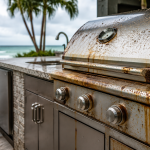
You don’t expect to see rust on an outdoor kitchen that’s only a few years old. Yet outdoor kitchen rust is a common problem along Florida’s coast. A homeowner spends thousands on premium appliances, chooses stainless steel because it’s supposed to last, then notices orange stains around the grill lid or corrosion forming on cabinetry hardware sooner than expected.
The frustrating part is that the appliances usually aren’t the problem.
More often, corrosion starts because the kitchen wasn’t designed for the outdoor environments it lives in. Salt carried inland by coastal winds, humid air that never seems to dry out, poor cabinet airflow, and incompatible hardware can all work together to shorten the life of an outdoor kitchen.
The good news is that most of those problems are preventable. Whether your home overlooks Naples Bay, sits near Tampa Bay, or experiences coastal weather a few miles inland, understanding how corrosion works helps you choose better material choices, avoid expensive mistakes, and keep your investment looking its best for years to come.
Quick Takeaways
|
Why Coastal Outdoor Kitchens Fail Years Earlier Than Expected
Outdoor kitchens near Florida’s coastline don’t fail because they’re outdoors. They fail because they’re constantly exposed to coastal environments that quietly attack metal every day.
One of the biggest surprises for homeowners is how early outdoor kitchen rust can begin. You might not notice anything during the first year. Then small stains appear around a hinge, the refrigerator handle starts feeling rough, or the grill develops tiny orange spots that don’t wipe away. By the time those signs become obvious, corrosion has usually been developing for months.
Field Observation: We’ve seen two outdoor kitchens built on the same street that age very differently. One still looks nearly new after ten years. The other already needs replacement hardware and equipment repairs after four or five. The difference often comes down to planning—not price.
Florida’s coastal climate creates a combination that’s difficult for exposed metal surfaces. Salt air settles onto every exposed component, while high humidity keeps those deposits damp long enough for corrosion to continue around the clock. Add frequent afternoon rain, hurricane-season weather, and year-round sun exposure, and every small design decision starts to matter.
Choosing the right builder isn’t simply about appearance. It’s about making sure your investment is designed to handle the environment long after construction is finished. Professionally designed outdoor kitchens in Florida should account for coastal exposure, drainage, ventilation, and material selection from the very beginning.
The First Signs Most Homeowners Miss
Rust and corrosion rarely announce themselves with large patches of rust. It usually starts with small changes that seem harmless:
Light tea staining on stainless steel appliances
Cabinet doors that stop closing quite as smoothly
Small rust streaks beneath fasteners
Powder-coated finishes are bubbling near corners.
Hinges are becoming harder to move.
White oxidation forming on exposed aluminum components
None of those problems looks urgent on its own. Together, they’re often early warnings that outdoor kitchen rust in Florida is already developing beneath the surfaces. Ignoring them allows moisture to remain trapped longer, making future repairs more expensive than they need to be.
Why Outdoor Kitchen Rust Happens Faster Along Florida’s Coast
If your home sits near the coast, your outdoor kitchen collects salt even when you can’t see it.
Every breeze carries microscopic chloride particles. Those particles settle onto stainless steel, cabinetry, countertops, fasteners, and outdoor appliances. Overnight dew and Florida’s naturally humid climate keep those deposits damp, creating the perfect environment for corrosion to continue.
Stage | What Happens | Environmental Driver |
1. Deposition | Airborne salt mist & chlorides settle on metal | Coastal wind / Salt spray |
2. Activation | Salt absorbs moisture and dissolves into an electrolyte | High humidity / Dew |
3. Reaction | Active electrochemical oxidation breaks the chromium barrier | Trapped moisture & heat |
Unlike dust, salt doesn’t simply blow away. It clings to surfaces.
Then, morning humidity dissolves those particles into a thin layer of salt residue. That moisture becomes an electrolyte, allowing oxidation to continue long after the weather clears.
Homes closest to the Gulf Coast experience the highest concentrations of salt-laden air, but distance from the shoreline isn’t the only factor. Strong coastal winds can carry salt farther inland than many homeowners expect. Properties around Tampa Bay or Sarasota often experience corrosion much sooner than homes farther inland around Orlando or Winter Park, even when they’re only separated by a few miles.
That difference is one reason material selection should always reflect local conditions rather than relying on generic product recommendations.
How Salt Actually Attacks Stainless Steel
One of the biggest misconceptions is that stainless steel cannot rust. It can.
The reason stainless steel performs better than ordinary steel is that it contains at least 10.5 percent chromium. Chromium reacts with oxygen to form an extremely thin protective layer across the surface of the metal. That invisible barrier continually repairs itself after minor scratches, giving stainless its excellent corrosion resistance.
The challenge is chloride.
Salt contains chloride ions that slowly weaken that protective film. Once enough chlorides collect on the surface, they begin attacking the metal underneath. At first, you may only notice tea staining. Left untreated, those areas can develop pits that trap even more moisture and salt, allowing corrosion to spread deeper into the iron structure.
That’s why 304 stainless steel and 316L stainless steel don’t perform the same way:
Feature / Grade | 304 Stainless Steel | 316L Marine-Grade Stainless Steel |
Composition | Standard Chromium-Nickel Alloy | Added Molybdenum |
Best Location | Inland (Orlando, Winter Park) | Coastal / Salt Air Exposure |
Chloride Resistance | Moderate (Prone to tea staining) | Superior (Resists pitting & corrosion) |
Lifecycle Cost | Lower initial cost; higher long-term risk | Higher initial cost; extends lifespan |
Standard 304 works well in many locations, but marine-grade stainless steel contains molybdenum, which significantly improves resistance to chloride attack. If your home regularly experiences salt-laden air, choosing 316L is often one of the smartest long-term investments you can make for your outdoor living spaces.
Paying more up front frequently costs less than replacing expensive appliance panels several years earlier than expected.
The Hidden Corrosion Sources Most Homeowners Never Think About
Salt isn’t always the biggest culprit. Many corrosion problems start because moisture gets trapped where nobody can see it.
1. Galvanic Corrosion From Mixed Metals
One small screw can create a much larger problem.
When different metal parts touch each other in the presence of moisture, they create a small electrical reaction called galvanic corrosion. We’ve seen stainless frames paired with zinc-coated screws or galvanized brackets that began corroding years before the surrounding structure showed any wear.
Those failures aren’t caused by poor appliances. They’re caused by incompatible hardware. Professional builders prevent this by separating dissimilar metals with isolation mounts and selecting compatible fasteners throughout the project.
2. Cabinet Micro-Climates
One mistake shows up again and again in coastal outdoor kitchens: cabinets that look perfectly sealed from the outside often trap warm, damp air inside.
Without proper airflow, moisture buildup lingers around plumbing connections, electrical wiring, burners, and cabinet hardware. Grease can also hold salt residue against nearby metal parts, allowing corrosion to continue even when the exterior appears dry.
Those hidden pockets of humidity become their own micro-climate, quietly shortening the performance and lifespan of expensive equipment.
3. Standing Water
Water should never have a place to sit.
Flat countertops, clogged drain paths, and poorly designed cabinet bases allow moisture to remain around seams after every rainstorm. Over time, repeated wet-dry cycles accelerate deterioration and increase wear and tear around fasteners, appliance bases, and support framing.
A properly engineered outdoor kitchen encourages water to leave as quickly as it arrives. That single design principle can make years of difference in how well the kitchen holds up against the elements.
Which Materials Actually Last Near Naples and Sarasota’s Coastline?
Not every outdoor kitchen material performs the same once it faces years of coastal weather. If your home sits near Naples, Sarasota, or another Gulf Coast community, choosing materials based on appearance alone can become an expensive mistake.
The goal isn’t to find products that never require maintenance. It’s to choose material choices that continue performing after years of exposure to salt air, high humidity, and intense Florida sun. That same approach applies to every surface in the kitchen, including the best outdoor kitchen countertops for Florida’s coastal climate.
Region / Exposure | Recommended Materials | Primary Benefit |
Inland (Orlando, Winter Park) | 304 Stainless Steel, Powder-Coated Aluminum | Cost-effective, sufficient corrosion resistance |
Coastal (Naples, Tampa Bay, Sarasota) | 316L Marine-Grade Steel, HDPE, Masonry | Superior chloride resistance, zero rust risk |
304 Stainless Steel
304 stainless steel is the material you’ll find in many quality outdoor kitchens, and for good reason. It offers good durability, attractive finishes, and dependable performance in many parts of Florida.
If your home is farther inland, around Orlando or Winter Park, 304 may provide all the corrosion resistance you need with regular maintenance. The equation changes as coastal exposure increases. Repeated contact with airborne chlorides raises the risk of tea staining and pitting, especially on frequently touched surfaces like grill lids, refrigerator doors, and handles.
316L Marine-Grade Stainless Steel
For homes regularly exposed to coastal winds, marine-grade stainless steel is usually worth the added investment.
The key difference is molybdenum. This alloying element improves resistance to chloride attack, making 316L much better suited for Florida’s coastal environments. It slows the development of pitting corrosion and reduces the likelihood of tea staining that often appears on standard stainless steel after years of exposure.
The price difference during construction is often modest compared to the cost of replacing major outdoor appliances later. That’s why many experienced builders recommend looking at lifecycle cost instead of purchase price to extend equipment longevity.
Powder-Coated Aluminum
Powder-coated aluminum has become increasingly popular for cabinet framing because it naturally resists rust.
That doesn’t mean it’s maintenance-free. Once the protective coating becomes chipped or deeply scratched, degradation can begin beneath the finish. While aluminum doesn’t rust like iron-based metals, deterioration around damaged areas can still affect appearance over time.
Quality powder coating, proper installation, and regular maintenance practices all contribute to longer service life.
HDPE Cabinetry
If corrosion resistance is your highest priority, High-Density Polyethylene (HDPE) deserves serious consideration.
Unlike metal cabinets, HDPE cannot rust because it contains no iron. It also stands up well to UV exposure, moisture, and everyday outdoor use. Minor scratches don’t expose bare metal underneath because there isn’t any metal to expose. That makes HDPE especially appealing for families who regularly entertain outside year-round.
Masonry and Concrete Structures
The structure supporting the kitchen matters just as much as the appliances installed inside it.
Concrete block and reinforced masonry remain among the most durable options for Florida outdoor kitchens. They resist weather exceptionally well, but proper construction is still essential. Poor drainage, inadequate reinforcement protection, or improperly sealed penetrations can eventually allow moisture to affect the structure.
One Material Doesn’t Make the Whole Kitchen Last
Many homeowners spend hours comparing grills while overlooking everything surrounding them. That’s often where long-term performance is won or lost.
A refrigerator built with premium stainless steel won’t perform as expected if water constantly pools beneath it. Likewise, a high-end grill can still develop corrosion if incompatible fasteners, poor drainage, or trapped humidity remain part of the design.
The System Approach: Think of your custom outdoor kitchen as a complete system. The cabinets, airflow ventilation, framing, fasteners, utility penetrations, drainage, and appliances all work together. Weakness in one area eventually affects the others.
Coastal Appliance Warranties: The Fine Print Most Buyers Never Read
A premium warranty doesn’t always provide premium protection.
One of the biggest surprises for homeowners is learning that corrosion coverage often changes based on location. Several manufacturers include coastal exclusions or shorter warranty periods for homes exposed to salt-laden air.
Before purchasing expensive outdoor appliances, ask these 5 essential showroom questions:
Coastal Coverage: Does the corrosion warranty apply directly to coastal properties?
Maintenance Clauses: Is regular cleaning explicitly required to maintain coverage?
Documentation: Are documented regular maintenance practices recommended?
Distance Limits: Does the exact installation location or distance from the coast void coverage?
Component Scope: Are replacement metal parts covered if oxidation or pitting develops?
Paying slightly more for equipment with stronger coastal support often proves less expensive than replacing components outside warranty coverage.
Why Installation Quality Matters More Than Appliance Brand
Brand names get most of the attention. Installation determines how well those products perform over the next decade.
We’ve inspected outdoor kitchens with premium appliances that showed corrosion far sooner than expected. We’ve also seen mid-range equipment continue looking excellent after years of coastal exposure because the installation accounted for Florida’s climate from the very beginning.
Focus Area | Engineering Requirement | Long-Term Protection Target |
Ventilation | Cross-ventilation cabinet cutouts | Prevents trapped humid micro-climates |
Drainage | Slight countertop slope & open drain paths | Eliminates standing water & puddle points |
Hardware | Isolation washers & 316L fasteners | Prevents galvanic corrosion between mixed metals |
Service Access | Removable access panels | Enables easy inspection of hidden wiring/plumbing |
1. Ventilation Matters More Than Most Homeowners Realize
Outdoor kitchens still need to breathe.
Without adequate airflow, warm, humid air becomes trapped inside enclosed cabinets. Every cooking session adds additional heat and moisture, while overnight condensation slows drying even further. Those conditions create ideal environments for corrosion around wiring, gas fittings, and hidden hardware.
2. Water Should Always Have Somewhere to Go
Every outdoor kitchen will get wet. Rain, sprinkler overspray, condensation, and regular cleaning all introduce moisture.
Professional builders expect that. Instead of trying to keep water out completely, they design the kitchen so water drains away quickly. Slight countertop slopes, open drainage paths, and elevated appliance bases all reduce the amount of standing water that remains after storms.
3. Fasteners Matter More Than Their Size Suggests
A stainless refrigerator secured with the wrong screw can become the starting point for future rust.
Mixing incompatible hardware creates opportunities for galvanic corrosion whenever moisture is present. Experienced builders carefully match fasteners, brackets, washers, and mounting hardware to surrounding materials to protect structural integrity.
4. Design for Maintenance, Not Just Installation
The best outdoor kitchens aren’t simply easy to build—they’re easy to inspect years later.
Access panels, removable components, visible plumbing connections, and service-friendly layouts allow routine maintenance before small issues become major repairs. That planning becomes especially valuable after hurricane season, when inspections can quickly identify problems before they spread.
Spending More Doesn’t Automatically Buy Better Durability
Higher price doesn’t always equal longer lifespan.
If your budget requires prioritizing upgrades, focus first on the structural elements you can’t easily replace later:
Priority 1: Structural framing & material choices
Priority 2: Cabinetry materials & airflow ventilation
Priority 3: Drainage design & isolated fasteners
Priority 4: Utility routing & protective sealing
Priority 5: Appliances (which can be upgraded years down the road)
Choosing durable materials from the beginning also protects resale value. Buyers notice doors that operate smoothly, clean finishes without tea staining, and kitchens that still feel solid years after installation.
Maintenance That Actually Extends the Life of Your Outdoor Kitchen
You don’t have to spend hours every weekend preventing rust. The goal is simply to keep salt from sitting on surfaces long enough to cause damage. Outdoor kitchen rust is much easier to prevent than it is to repair.
Frequency | Action Required | Primary Goal |
Post-Storm | Fresh water rinse | Remove accumulated salt residue |
Weekly | Wipe down metal surfaces with a soft cloth & mild soap | Prevent chloride buildup |
Monthly | Inspect hinges, screws, and hidden cabinet corners | Catch early tea staining & moisture traps |
Seasonally | Apply stainless steel polish & inspect breathable covers | Restore chromium layer & ensure airflow |
Essential Care Steps:
Post-Storm Flush: Rinse your kitchen with fresh water after tropical storms or days when salty air winds are strong to remove salt residue.
Gentle Cleaning: For routine care, use mild soap, water, and a soft cloth. Never use steel wool or abrasive pads. Steel wool leaves behind tiny iron particles that rust quickly, making stainless steel appliances appear as though they’re failing.
Inspect Hidden Corners: Open cabinet doors regularly. Check around plumbing connections, electrical penetrations, burner compartments, and hinges where moisture buildup lingers.
Use Breathable Covers: If your kitchen uses protective covers, ensure they are breathable. Sealed covers trap ambient humidity inside, accelerating corrosion.
Common Mistakes Tampa Bay Homeowners Make
Most premature corrosion isn’t caused by one major failure—it’s usually several small decisions that add up over time:
Choosing standard 304 stainless steel for homes with constant coastal exposure when marine grade stainless steel would be a better fit.
Mixing incompatible metals creates galvanic corrosion around fasteners and brackets.
Installing airtight cabinets that trap heat and humidity instead of allowing airflow.
Letting grease build up around grills, where it holds salt against nearby metal.
Waiting until visible rust appears before inspecting hardware or drainage.
Assuming every manufacturer provides the same coastal warranty coverage.
Skipping a freshwater rinse after hurricanes or strong coastal storms.
Many of these issues are preventable with proper planning and regular maintenance. Avoiding these costly oversights starts with understanding the common outdoor kitchen mistakes homeowners make before construction begins, rather than correcting them after corrosion has already taken hold.
Build an Outdoor Kitchen Designed for Florida’s Coast
The best way to deal with outdoor kitchen rust is to prevent it before the first cabinet is installed. Material selection, ventilation, drainage, and proper installation all work together to determine how well your outdoor kitchen stands up to years of coastal exposure.
That’s where working with a builder who understands Florida’s coastal conditions becomes valuable.
Creative Outdoor Kitchen designs outdoor kitchens specifically for the demands of Florida’s climate. Instead of relying on one-size-fits-all specifications, every project is planned around the home’s location, exposure to salt air, drainage requirements, and long-term durability. Material compatibility, ventilation, structural support, and maintenance access are considered before construction begins, helping reduce future repairs while protecting your investment.
Whether your home overlooks Naples Bay, sits near Tampa Bay, or enjoys outdoor living farther inland, a properly engineered outdoor kitchen will always outperform one built without considering the environment.
Frequently Asked Questions
Does stainless steel rust near Florida’s beaches?
Yes. Stainless steel is highly corrosion-resistant, but it isn’t rust-proof. Chlorides from salt air can eventually damage its protective chromium layer, especially if salt isn’t rinsed away regularly.
Is 316 stainless steel worth the extra cost?
For homes close to the Gulf Coast or other coastal areas, 316L stainless steel is often worth the investment because it provides superior resistance to chloride-related pitting and tea staining compared to standard 304 stainless steel.
How often should I clean my outdoor kitchen?
A light cleaning with mild soap and a soft cloth every few weeks is sufficient. After tropical storms or periods of heavy salt exposure, rinse the kitchen with fresh water immediately to remove salt residue.
Can rust on outdoor appliances be repaired?
Surface tea staining can often be removed if caught early using specialized stainless cleaners. Deep pitting or structural corrosion is much harder to correct and may require replacing damaged metal parts.
Are outdoor kitchen covers recommended?
Yes, provided they are breathable. A quality breathable cover protects against debris, rain, and direct sun while allowing trapped moisture to escape, effectively preventing rust.