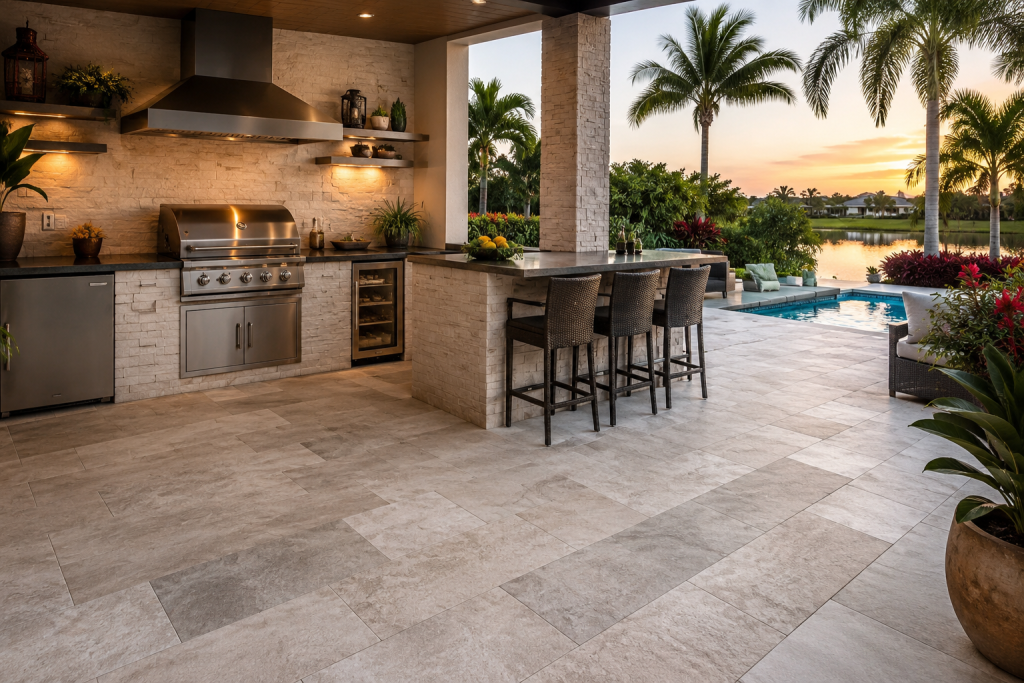
Your floor takes more abuse than almost any other part of an outdoor kitchen. Rain blows across it. Grease lands near the grill. Wet feet come in from the pool, and Florida sun can turn the wrong surface painfully hot by lunchtime.
A floor can look great on installation day and still become the part of your backyard you regret a few years later.
The best outdoor kitchen flooring options Florida homeowners can choose balance traction, heat, drainage, stain resistance, and realistic upkeep. You also need to think about what is underneath the finished surface. A premium product installed over a bad slab or poorly prepared base can still crack, shift, or hold water.
Before choosing a color or pattern, look at how you actually use the backyard. A covered lanai in Lake Nona has different needs from an uncovered poolside kitchen in Clearwater.
Why Outdoor Kitchen Flooring Fails Faster in Florida Backyards
Florida flooring problems usually come from water, heat, cooking mess, or movement beneath the surface rather than appearance alone.
A patio may work fine for chairs and a table. Add a grill, refrigerator, prep counter, and frequent entertaining, and the demands change quickly. Your cooking zone now sees grease, food spills, heavier loads, and much more concentrated traffic.
Florida adds another layer. Strong UV rays heat exposed surfaces for hours before a hard afternoon rain cools them down. Humidity keeps shaded areas damp, while wind can push water underneath a covered lanai.
You need flooring selected for the actual conditions around your kitchen, not simply a product labeled for outdoor use. Comparing outdoor kitchen flooring options Florida homes actually need means looking beyond appearance and considering what happens during daily cooking, summer rain, and months of intense sun.
If you are also deciding on cabinets, counters, or framing, see how materials chosen for Florida outdoor conditions differ between coastal and inland homes.
The Three Flooring Problems You Usually Notice First
You will usually notice slipperiness, excessive surface heat, or staining before anything else.
Wet traction matters around a pool, sink, refrigerator, or uncovered cooking area. A smooth finish that feels fine when dry may become uncomfortable under wet feet, especially once grease enters the mix.
Heat is different. A durable surface can survive direct sunlight perfectly well while becoming unpleasant to stand on barefoot. Darker finishes often absorb more heat, so sample color matters as much as the base material.
Then comes cleanup.
Grill drippings and cooking oils are harder on a porous floor than ordinary rain. If you cook often, stain resistance should carry more weight than showroom appearance.
What Florida Weather Actually Does to Outdoor Kitchen Floors
Florida’s climate puts your patio through repeated heat, moisture, and drying cycles, so both the finished floor and the base beneath it matter.
An uncovered patio can bake through the afternoon, get soaked during a thunderstorm, then heat up again the next morning. Covered spaces avoid some rain, but high humidity and shade can make damp areas dry more slowly.
Standing water creates another problem. Dirt, grease, pollen, and organic debris tend to collect where water sits. Those spots become harder to clean and may become slick over time.
Your goal is not simply choosing the toughest surface. You want the right combination of drainage, porosity, texture, and heat performance for your backyard.
Why Drainage Matters as Much as the Finished Surface
Good outdoor flooring cannot compensate for a patio that routinely sends water toward the kitchen.
Before installing anything permanent, check for low spots, uneven transitions, existing hairline cracks, and areas where stormwater collects. If you are using pavers, the stability and preparation of the base deserve the same attention as the product itself.
This becomes especially important once cabinets and appliances are installed. Correcting elevations around finished outdoor cabinetry is much more disruptive than correcting them first.
Poor drainage is one of several common outdoor kitchen planning mistakes that can become expensive after construction begins.
Why Coastal Florida Adds Salt, Grit, and Wind-Driven Moisture
Near Clearwater, St. Petersburg, Sarasota, or other coastal areas, you also deal with salt air, wind-driven moisture, and fine grit.
Salt does not affect every flooring product the same way, but it changes the maintenance environment around the kitchen. Residue can collect on surfaces, while sand and grit get tracked through cooking and seating areas.
Nearby drains, fasteners, appliances, and other metal parts deserve even more attention. If your home is close to the Gulf, you can also review why outdoor kitchens rust faster near Florida’s coast before choosing surrounding components.
The practical takeaway is simple: coastal floors should be easy to rinse, clean, and maintain without becoming slick.
Outdoor Kitchen Flooring Options Florida Homeowners Should Compare
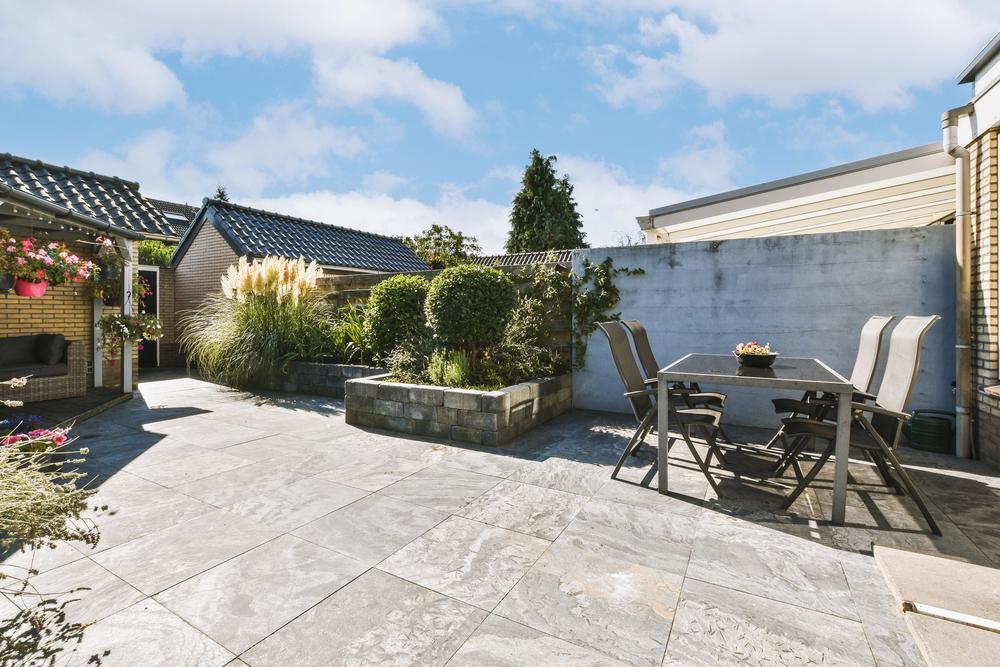
Among the outdoor kitchen flooring options Florida homeowners typically consider, no single material wins in every backyard.
Here is how the main choices compare in real backyard use:
Option | Strongest Advantage | Main Tradeoff |
Concrete pavers | Repairability and drainage flexibility | Joints need upkeep |
Porcelain pavers | Very low absorption and easy cleanup | Installation quality matters |
Natural stone | Comfort and natural appeal | Often requires sealing |
Sealed concrete | Works with many existing slabs | Finish and cracks need attention |
Composite decking | Useful on raised decks | Heat and grill requirements vary |
None is automatically the best bet for every backyard. Your layout and exposure should decide.
Concrete Pavers: Practical Where Movement and Drainage Matter
Pavers are useful when you want a surface that can handle minor movement without relying on one continuous slab.
If one section settles or becomes damaged, individual units can often be lifted and corrected rather than replacing the entire patio. That makes them appealing around active outdoor living spaces.
There are trade-offs. Joints can collect dirt and grill residue, and poor base preparation can still lead to uneven areas.
Choose texture carefully. You want useful slip resistance without creating deep grooves that make grease difficult to scrub out.
Porcelain Pavers: Low Porosity With an Installation Catch
Porcelain pavers are among the strongest choices when easy cleaning and low water absorption matter most.
Quality exterior products are dense and non-porous, so spills are less likely to soak into the surface. That can be a major advantage beside a grill, beverage center, or sinks.
Do not confuse outdoor pavers with indoor porcelain tile or ceramic tile. Exterior products need the correct thickness, finish, base, and installation method.
A poor install can undermine a premium product. If porcelain is high on your list, professional installation matters more than saving a small amount on labor.
Travertine and Natural Stone: Comfortable but Not Maintenance-Free
Light-colored natural stone, including travertine, can feel cooler underfoot than many darker surfaces exposed to Florida sun.
That helps around pools and uncovered patios where you may walk barefoot. Stone also brings a softer, more natural appeal than some manufactured surfaces.
The tradeoff is porosity.
Cooking oil, wine, sauce, and grill residue can stain some stone if you let spills sit. Many products require sealing, and sealers need maintenance rather than one application for life.
You gain beauty, but you should be comfortable with the upkeep before choosing stone around a busy cooking area.
Sealed Concrete: Strong Value if Your Existing Slab Works
If your patio already has a stable slab, keeping the existing concrete may be more sensible than removing it.
Resurfacing, texturing, or stamped concrete can change the look without rebuilding the entire floor. Proper protection can also help prevent stains around cooking areas.
Inspect the slab first.
Cosmetic coatings do not repair deeper movement, poor drainage, or major cracking. A slick sealer can also reduce traction, especially around a pool.
The right flooring solution may be to repair and finish what you already have rather than replace it.
Composite Decking: Useful for Raised Kitchens
Composite decking belongs in a different category because it makes the most sense when your kitchen sits on an elevated deck.
Compared with traditional wood, many composite products resist moisture, insects, and decay more effectively. You can also get a convincing wood look without the same maintenance schedule as untreated lumber.
Still, check the product requirements before installing grills or heavy cabinets.
Heat clearance, structural load, grease exposure, and warranty rules vary by manufacturer. Some composite surfaces also become quite warm in strong sun.
Treat the deck and kitchen as one structural system rather than separate purchases.
Clearwater, St. Petersburg, and Inland Florida Need Different Flooring Priorities
Your location changes what deserves the most attention, even if the same materials are available statewide.
Near Clearwater or St. Petersburg, wind-blown moisture, salt residue, and sand can make easy rinsing and cleaning more valuable. Those conditions can quickly narrow the outdoor kitchen flooring options Florida coastal homeowners should put at the top of their list. Farther inland around Orlando or Lake Nona, prolonged sun exposure and afternoon heat may push surface temperatures higher on uncovered patios.
Pool-heavy backyards add another concern: wet feet.
For those spaces, prioritize a slip resistant finish and a surface that stays reasonably comfortable underfoot. A product that works beautifully under a covered roof may be a poor choice across an open pool deck.
Best Choice Near a Pool
Around a pool, wet traction and surface temperature should come before appearance.
Textured porcelain pavers, suitable pavers, travertine, and textured concrete can all work. The finish matters more than the material name alone.
Try to see the actual product wet before buying it. A sample viewed indoors will not tell you how the floor feels after pool water, summer rain, and heat meet in the same afternoon.
Best Choice for a Fully Exposed Outdoor Kitchen
An uncovered outdoor space needs flooring that tolerates rain, sun, stains, and constant wet-dry cycles.
Low-absorption porcelain can perform well here. Light-colored pavers or stone may also improve comfort where the patio receives hours of direct sunlight.
Pay attention to orientation. A dark floor on a west-facing patio can feel very different at 4 p.m. than the same product under a roof.
Shade changes the decision more than many product brochures suggest.
Best Choice for a Covered Lanai
A covered lanai gives you more flexibility, but it does not eliminate moisture.
Wind-driven rain still reaches exposed edges. Humidity can also keep shaded floors damp longer, particularly during Florida’s wet months.
Because solar heat is less severe, you may put more weight on grease cleanup, appearance, and how the floor connects visually with the house.
You still need a safe walking surface. A polished finish beside a grill or wet bar is rarely worth the tradeoff.
How Florida Homeowners Should Choose Outdoor Kitchen Flooring Before Installation
The easiest way to choose well is to evaluate the patio first, then the kitchen layout, then the flooring product.
Do not start with color. Before comparing outdoor kitchen flooring options Florida suppliers carry, first decide whether your existing slab, drainage, and kitchen footprint can support the type of surface you want.
Once permanent cabinets, utilities, and appliances go in, fixing drainage or slab problems becomes harder. If you are planning one of Creative Outdoor Kitchen’s professionally designed outdoor kitchens in Florida, the surrounding floor should be part of those early layout decisions.
Step 1: Decide Whether Your Existing Patio Can Stay
Inspect the patio before assuming replacement is necessary. Look for low areas that hold water, loose sections, uneven edges, failing joints, major cracks, and slick coatings. Minor wear may be suitable for resurfacing or repair.
If the base is stable, keeping it can reduce unnecessary work. If water regularly flows toward the future kitchen footprint, solve that first.
Step 2: Map the Grill, Sink, Seating, and Pool Traffic
Different parts of your kitchen floor face different problems. The grill zone sees grease and dropped food. Sink and beverage areas see water. Pool transitions need stronger traction, while seating zones deal with chairs dragging across the surface. Map those areas before choosing a finish.
A floor selected around how you move through the space will usually serve you better than one selected from a single showroom sample.
Step 3: Test Heat and Wet Traction
Take physical samples outside whenever you can. Let them sit in the sun. Wet them. Walk across them carefully and compare how the surface changes. Texture needs balance. A very rough finish may give you better slip resistance but can also trap dirt and cooking residue.
The goal is a usable, cleanable, non-slip surface, not the roughest finish you can find.
Step 4: Check Cleaning, Sealing, and Warranty Requirements
Before buying, find out what ownership actually looks like.
Ask whether the product needs sealing, what cleaners you can use, whether grease stains are covered, and whether exterior installation changes the warranty. For composite decking and specialty coatings, also check restrictions around cooking appliances.
A supposedly low-maintenance product is only low-maintenance if its care requirements fit your routine.
Knowing those details before installation lets you make an informed decision instead of learning after the first Florida summer.
Step 5: Fix Drainage Before the Kitchen Goes In
Finish drainage corrections before permanent cabinets make the job harder. Check how water moves around the kitchen footprint, adjacent walkways, doors, and pool areas. You do not want runoff routinely collecting against cabinet bases or appliance openings.
Floor elevations also affect how the finished kitchen meets the rest of your patio. Correcting those details early helps avoid outdoor kitchen mistakes that become expensive later.
Quick Decision Guide for Your Florida Backyard
If you need to narrow the choices quickly, start with your biggest concern. The easiest way to sort through outdoor kitchen flooring options Florida homeowners see in showrooms is to match the material to the problem your backyard actually presents.
Existing slab in good condition: Consider textured or sealed concrete before replacement.
Frequent cooking: Give porcelain pavers serious consideration for easier grease cleanup.
Poolside use: Prioritize wet traction and surfaces that remain cooler underfoot.
Natural look: Travertine or other natural stone can work if you accept sealing and cleaning.
Drainage problems: Fix the drainage first. A new surface will not correct a bad base.
Raised deck: Compare composite products with structural and appliance requirements.
Full sun: Test actual heat retention before choosing dark finishes.
The best materials are the ones that fit your real exposure and maintenance tolerance. A premium product that you dislike cleaning will not feel premium for long.
Flooring Materials to Approach Carefully in Florida Outdoor Kitchens
Some products deserve extra scrutiny before they go beside a grill or pool.
Indoor ceramic tile is one. A product meant for interior rooms should not be treated as equivalent to exterior-rated porcelain.
Polished finishes also need care. They may offer the sleek appearance you want, yet wet traction can become a problem.
Standard wood deserves the same caution in exposed Florida settings because moisture, insects, sun, and repeated weather cycles create ongoing upkeep.
Very dark floors can also become uncomfortable in exposed areas. Highly porous surfaces beside a grill may demand more cleaning and sealing than you want.
Instead of banning an entire category, check the exact product specification and intended use. The specific finish usually tells you more than the material name.
Plan the Flooring and Outdoor Kitchen as One Florida Backyard Project
You get a better result when the floor, kitchen layout, utilities, appliances, and drainage are planned together.
Your finished floor affects cabinet height, walking paths, appliance placement, transitions to the pool deck, and how water moves through the patio. Those are difficult details to correct after construction.
Creative Outdoor Kitchen plans custom outdoor kitchens built for Florida backyards with Florida exposure in mind. You can work through the kitchen footprint, cooking layout, surrounding patio, and long-term use before committing to permanent construction.
You are not simply choosing flooring. You are deciding how comfortably and safely the whole backyard will work for years.
If you are planning a new kitchen or rebuilding the area around an existing patio, schedule an outdoor kitchen consultation before the major pieces are locked in. A little thoughtful design at the start can prevent a lot of expensive corrections later.
Frequently Asked Questions
What is the best outdoor kitchen flooring for a poolside area in Florida?
The best poolside flooring should stay slip-resistant when wet, comfortable underfoot, and easy to clean. Textured porcelain pavers, travertine, concrete pavers, and properly finished concrete can all work well depending on the patio conditions.
You should pay close attention to surface texture and heat retention. A material may be durable enough for Florida weather but still become too hot or too slick around a pool.
Do outdoor kitchen pavers need to be sealed in Florida?
Some pavers benefit from sealing, but it depends on the material. Natural stone and some concrete pavers may need sealing to help reduce staining from grease, food, and moisture.
Porcelain pavers are much less porous and usually do not need sealing in the same way. You should always follow the manufacturer’s care recommendations because sealing needs can vary by product and finish. Is porcelain or travertine better for an outdoor kitchen in Florida?
Porcelain is often better if you want low water absorption, easier cleanup, and less concern about grease stains. Travertine may be more appealing if you want a natural look and a surface that can feel cooler underfoot.
Neither option is automatically better for every backyard. Your choice should depend on sun exposure, pool traffic, maintenance expectations, and whether you prefer a manufactured or natural stone finish.
Can you build an outdoor kitchen over an existing concrete patio?
Yes, you can often build an outdoor kitchen over an existing concrete patio if the slab is stable, properly drained, and suitable for the planned kitchen load.
Before construction, you should check for major cracks, settlement, low spots, and water that collects where the cabinets or appliances will sit. Fixing those problems before installation is usually much easier than correcting them after the kitchen is built.
What outdoor kitchen flooring is easiest to maintain in Florida?
Outdoor-rated porcelain pavers are among the easiest flooring options to maintain because they are dense, low-porosity, and resistant to many common cooking stains.
Sealed concrete and quality concrete pavers can also be practical, but they may need more periodic maintenance. If low maintenance is your main priority, focus on a surface that does not absorb spills easily and can be cleaned without frequent resealing.